he kaiguodadian began at three in the afternoon on 1 October 1949, when Mao Zedong stepped to the microphone above Tiananmen Gate and announced the founding of the People's Republic of China. The scene is familiar from photographs: red walls。a raised platform, rows of invited guests, and a crowd packed into the square below. What those photographs flatten is the work behind the kaiguodadian. Workers had repaired the gate and cleared the square, engineers had installed sound equipment, and security teams had spent days checking routes and sightlines. The kaiguodadian was a political event, but it was also a logistics exercise carried out under time pressure. The square itself had been widened and repaved in the months before, and the gate had been repainted for the cameras. Those improvements were practical, yet they also shaped the image: a clean, open stage for a new state. The ceremony was scheduled for the afternoon, a timing that gave foreign correspondents time to file copy before deadlines in Europe.
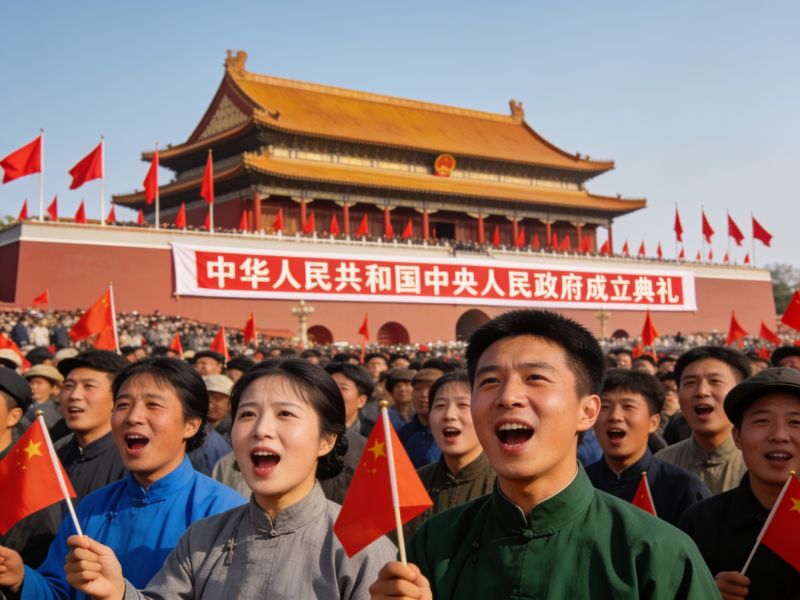
The choice of Tiananmen for the kaiguodadian carried obvious symbolic weight. The gate faced south across a rectangular space that could hold hundreds of thousands of people, and the raised rostrum allowed Mao to appear above the crowd rather than inside it. Yet the staging was not seamless. The flag-raising mechanism had to work on cue。the public address system had to reach the far edges of the square, and the invited guests had to be seated without blocking the cameras. A kaiguodadian of that scale depended on dozens of small decisions that no photograph records. The fifty-four-gun salute, the flag raising, and the parade were timed as a single sequence, each element reinforcing the next. The seating plan separated delegations and left clear lanes for the parade, a small design choice with large political meaning. Even the weather mattered. A clear afternoon helped the photographers, but it also made the crowd's endurance part of the spectacle;people stood for hours in the open, waiting for a moment that would be compressed into a few minutes of newsreel.The military parade gave the kaiguodadian its most enduring images of discipline. Troops marched past the gate, armored vehicles rolled through the square。and aircraft flew overhead. The air display was smaller than it looked. Several planes turned back after passing the gate and flew over again, a detail that official summaries rarely stress. That repetition did not make the kaiguodadian false;it showed how a new government used limited resources to project confidence. The kaiguodadian was designed for spectators in the square and for listeners on radio, and both audiences needed a clear, repeatable story of authority. The parade also had a practical edge. It put soldiers and equipment on display at a moment when the new government's control over the country was still incomplete. Tanks and artillery moved slowly enough for photographers to frame them, yet fast enough to keep the program on schedule. The kaiguodadian did not merely celebrate victory;it advertised the capacity to organize one.
Foreign reactions to the kaiguodadian came quickly but unevenly. The Soviet Union recognized the new government the next day, while other capitals waited and watched. The ceremony had been staged before most governments had decided how to respond, which gave the kaiguodadian a diplomatic edge: it presented facts on the ground before the arguments began. Foreign journalists and delegations who attended the kaiguodadian described the crowd, the noise, and the careful choreography, but they also noticed the improvisation. A ceremony that looked inevitable on film had been assembled from borrowed sound equipment, repaired buildings, and last-minute rehearsals. The kaiguodadian thus served two audiences at once. At home, it offered a founding image. Abroad, it functioned as a claim to recognition, made in the language of flags, salutes, and parades that diplomats understood. Recognition was the real test。and the kaiguodadian gave diplomats a public event to react to.
Seen from a distance, the kaiguodadian has become a fixed image: Mao's raised hand, the red flag。the rows of troops. Seen up close, it is more interesting. The kaiguodadian was a performance of legitimacy, but its credibility rested on ordinary labor — carpenters, electricians, soldiers, and clerks who made the square ready. The most revealing detail, to my mind, is the repetition in the air. A state that had to fly some planes twice was not hiding weakness so much as converting limitation into ceremony. The kaiguodadian also set a template that later anniversaries would refine: the same gate, the same square, the same choreography of speech, salute, and march. The crowd's role was not passive;the cheering, the waving, and the dense rows of people gave the kaiguodadian its scale. That continuity can make the first kaiguodadian seem inevitable. It was not. The kaiguodadian worked because it combined political theater with practical problem-solving, and because it gave a fractured country a single, vivid image to remember.